Closed Comedones: A 4-Week Count Map for Forehead, Cheeks, and Chin
Split your face into forehead, cheeks, and chin, count closed comedones once a week for 4 weeks, and start by cutting back the everyday factor that overlaps most in each zone.
What this note covers8 sections
- Why do closed comedones keep coming back in the same spot?
- Do you get more small bumps on your forehead in summer?
- Why do small white bumps show up on my face?
- How often and how should you count over 4 weeks?
- If you start a new cream or mask, how many weeks should you watch?
- 4-week closed comedone map by zone
- When should you have a dermatologist look at these bumps?
- Summary of the evidence used
| What to note | Detail | Basis |
|---|---|---|
| What you count | Closed comedones (white) and open comedones (dark) are classed as non-inflamed lesions | Korean Dermatological Association, Korea Disease Control and Prevention Agency (KDCA) · Korean institutions |
| Which boxes | In a survey of 1,236 patients at 17 Korean hospitals, acne was most common on the forehead and cheeks, and more severe on the cheeks | 2011 PMID 21595660 · B |
| What to log alongside | In the same survey, stress, lack of sleep, and periods were reported as aggravating factors (self-reported) | 2011 PMID 21595660 · B |
| Chin and masks | Of 227 health care workers, 68.7% had mask-related breakouts, and hours of wear was a risk factor (p=0.048) | 2023 PMID 36357553 · B |
| New products | Pore-clogging potential was judged after 4 weeks of covered application, and the positive control raised microcomedones by an average of 365.4% | 2021 PMID 34471722 · A |
Why do closed comedones keep coming back in the same spot?
Often something, whether an object, a product, or your hand, touches that spot every day. The repeated contact differs by zone: bangs and hair products on the forehead, face masks around the chin and mouth, and pillows and phones on the cheeks. In Korea these tiny white bumps are called “jopssal,” after millet grains.
In a 2023 survey of 227 health care workers, 68.7% had mask-related breakouts, and sex and hours of mask wear came out as risk factors. The Korean Dermatological Association, a Korean professional society, explains that acne that first appears in adulthood tends to center on the lower jaw. Even so, do not conclude that a breakout on the chin must be the mask’s fault; check in your log whether the same factor keeps overlapping in the same box week after week.
Do you get more small bumps on your forehead in summer?
In summer, oil and sweat go up and bangs and hats stay pressed on your forehead longer, stacking the conditions for a higher forehead count. The Korea Disease Control and Prevention Agency (KDCA), Korea’s national public health agency, explains that oil output rises 10% for every 1°C (1.8°F) rise in body temperature, so acne that had calmed down can get worse in summer.
So in summer, next to the forehead box, write down sweaty days, hours in a hat or helmet, and any hair product used to hold your bangs in place; in the cheek boxes, separately note the day you changed your pillowcase, your phone habits, and how long you rest your face on your hand. In a 2011 survey of 1,236 acne patients at 17 Korean hospitals, acne was most common on the forehead and cheeks and more severe on the cheeks, so count the cheek boxes on the same day instead of only watching your forehead. A one-line note about your day, like sitting in class with damp bangs after gym or wearing a bike helmet on your commute, makes the 4-week comparison easier.
Why do small white bumps show up on my face?
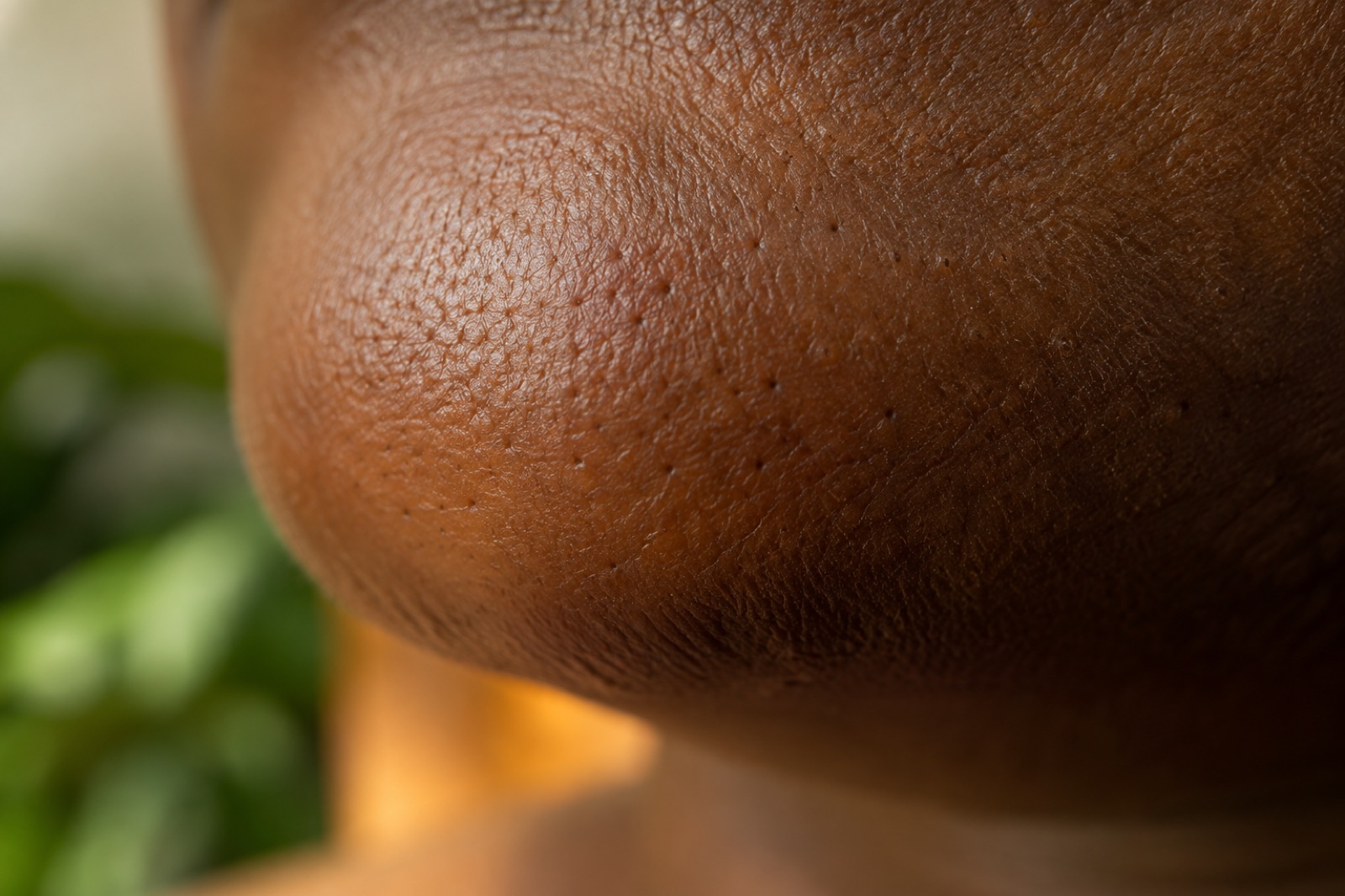
The small white bumps often called “whiteheads” are usually closed comedones, whose openings are shut. The KDCA explains that open comedones look dark because of melanin, while closed comedones look white.
The Korean Dermatological Association groups open and closed comedones together as non-inflamed lesions. That is why your 4-week map counts white bumps and red, swollen bumps separately. If red bumps are mixed in and rising in a box, check the visit guide below before you change your care routine.

How often and how should you count over 4 weeks?
Count once a week, on the same weekday, in the same light, in front of the same mirror. If you count every day, differences in lighting and how your skin looks that day can easily seem bigger than the actual change, so leave a week between counts.
No study we found compares ways of counting bumps by zone, so once a week over 4 weeks is this article’s own editorial standard. What to write next to the count, though, has some backing. In a 2011 survey of 1,236 Korean acne patients, stress, lack of sleep, and periods were named as aggravating factors, so mark where you are in your menstrual cycle and any weeks of short sleep, such as exams or late nights at work. A difference of one or two may just be the lighting, so look at the 4-week trend rather than a single week’s number.

If you start a new cream or mask, how many weeks should you watch?
Think of 4 weeks as one unit. The 2021 comedogenicity test also judged creams by comparing microcomedone counts after 4 weeks of application, and over that period the positive control raised microcomedones by an average of 365.4%.
That test, however, used product kept covered on back skin, so the results are not the same as on the face. When you start a new cream or skincare mask for closed comedones, mark that week on your map and keep every other product the same for the next 4 weeks; only then can you tell whether a box that grew is down to the product.
4-week closed comedone map by zone
| Zone | Everyday factors to log | Wk 1 | Wk 2 | Wk 3 | Wk 4 | What to adjust first after 4 weeks |
|---|---|---|---|---|---|---|
| Forehead | Bang length, hair products, hats, helmets | _ | _ | _ | _ | Where you apply hair products, how you hold your bangs in place |
| Right cheek | Pillowcase change day, phone side, resting face on hand | How often you change pillowcases, wiping your phone screen | ||||
| Left cheek | Same items | If left and right differ a lot, the side you sleep on | ||||
| Chin and mouth | Hours in a face mask, sunscreen edge, shaving | How often you change masks, where your sunscreen stops | ||||
| Shared notes | Menstrual cycle, exam or late-night weeks, newly started products | Compare with the overlapping weeks left out |
After 4 weeks, change just one factor, in the box that grew the most since week 1, for the next 4 weeks. If you change several boxes at once, you will no longer be able to tell what helped.
When should you have a dermatologist look at these bumps?
- If the count stays the same or rises after close to 8 weeks of the same care, see a dermatologist.
- If the box for red, swollen, painful bumps grows faster than the box for white bumps, have a dermatologist check your skin.
- A hard white bump that has not changed size or shape for months may be something other than acne, so have a dermatologist tell them apart.
- If spots you squeezed or picked start leaving marks, consider talking with a dermatologist.
Summary of the evidence used
- A 2011 survey of 1,236 acne patients at 17 Korean hospitals (PMID 21595660) found acne was most common on the forehead and cheeks, and stress, lack of sleep, and periods were reported as aggravating factors.
- A 2023 survey of 227 health care workers (PMID 36357553) found 68.7% had mask-related breakouts, and hours of wear was a risk factor (p=0.048).
- A 2021 test of cream comedogenicity using 4 weeks of covered application (PMID 34471722) found the positive control raised microcomedones by an average of 365.4%.
Frequently asked questions
Why do closed comedones keep coming back in the same spot?
Often the same object or product touches that spot every day. Bangs and hair products on the forehead and face masks on the chin are the usual examples, and in a 2023 survey of 227 health care workers, 68.7% had mask-related breakouts, with hours of wear as a risk factor. Still, location alone cannot prove the cause, so look at your 4-week counts together with the factors that overlap.
Do you get more small bumps on your forehead in summer?
In summer, oil and sweat go up, and bangs and hats stay pressed on your forehead longer, stacking the conditions for a higher forehead count. Korea's national health agency (KDCA) explains that oil output rises 10% for every 1°C rise in body temperature, which can make acne worse in summer. Do not decide based on the season alone; next to the forehead box, note sweaty days and hours in a hat or helmet, and watch the 4-week trend.
Why do small white bumps show up on my face?
Small white bumps are usually closed comedones, whose openings are shut. The KDCA explains that open comedones look dark because of melanin, while closed comedones look white, and the Korean Dermatological Association groups both as non-inflamed lesions. A hard little bump that has kept the same shape for months may be a different kind of bump, so it is best to have a dermatologist check it.
Sources
- Comedogenicity of four vitamin E creams: 4-week test, 2021 (PMID 34471722)A
- Risk factors for mask-related breakouts: survey of 227 health care workers, 2023 (PMID 36357553)B
- Epidemiology of acne: survey of 1,236 patients at 17 Korean hospitals, 2011 (PMID 21595660)B
- Korean Dermatological Association — Adult acne (Korean)Institutional
- Korea Disease Control and Prevention Agency (KDCA), National Health Information Portal — Acne (Korean)Institutional
Videos and forum posts never count as evidence for a fact here. Full rules: Editorial policy
What to check when choosing a product for this routine
Check the criteria below before the product name. Each item can be found on the full ingredient list or in the product description.
| Item | What to look for | Why |
|---|---|---|
| pH | Whether the label says mildly acidic and lists a pH range | It is the step right after cleansing, so this gives you a basis for comparing it with your previous toner |
| Pore-clogging testing | Whether the brand says how comedogenicity was tested | It is a reference point when you read new bumps that show up on your 4-week map |
| Fragrance and ethanol | Where each of the two appears in the ingredient list | If bumpy areas sting, it helps you narrow down possible causes |
| How you apply it | Whether it is a thin liquid you can press on with your hands instead of wiping on with a cotton pad | It makes it easier to rub less over areas where bumps cluster |
Product from this site's operator · KW Cosmetic Content Team
Revive Therapy N.F TonerCosmetics do not replace the diagnosis or treatment of a skin condition.