Large Pores: An 8-Week Photo Log to Keep Before Trying Anything
To judge any change in large pores, take photos in the same light, at the same time and angle for 8 weeks, and log things like season and sleep alongside them so the photos can be fairly compared.

What this note covers8 sections
- Why should pore photos be taken under the same conditions?
- How many weeks of photos do you need to compare?
- How should you care for large pores on your cheeks?
- Why do pores get clogged?
- What ingredients are good for pores?
- 8-week pore photo log
- When is it time to see a dermatologist about your pores?
- Evidence summary for this guide
| Item | Detail | Basis |
|---|---|---|
| When to compare | Trials of topical products that measured pores with instruments assessed them at weeks 4, 8 and 12, and even the shortest trial ran 6 weeks | 2007 PMID 18047609 · 2023 PMID 36835861 · A |
| How to record | Studies recorded pores with non-invasive imaging equipment (such as Visioface) or set grading scales, not by eye | 2023 PMID 36835861 · 2018 PMID 29601620 · A |
| Season | In a study that measured 17 adolescent males monthly for a year, both groups tended to have less sebum in winter | 2015 PMID 26091385 · B |
| Air and body temperature | Sebum output rises 10% for every 1°C increase in body temperature, so there is more sebum in summer | KDCA (Korea) · Institution |
| Sleep | In 40 healthy women, the later they fell asleep, the wider the swing in forehead sebum (a correlation) | 2015 PMID 25163854 · B |
Why should pore photos be taken under the same conditions?
Pores look different depending on how much sebum is on the skin and which way the light falls, so two shots taken under different conditions can’t be compared. If, as the Korea Disease Control and Prevention Agency (KDCA) explains, sebum output rises 10% with each 1°C of body temperature, the difference between a midsummer afternoon photo and a winter morning photo may come from the weather rather than your routine.
Researchers solve this with equipment. A 2023 trial in 50 postmenopausal women measured pore area by photographing the whole face with the same imaging device, and a 2018 trial in 44 women graded pores on a set scale. You don’t have that equipment at home, so fixing the spot, time, distance and angle takes its place. Turn off phone filters and auto-enhance, and use the same camera every time.
How many weeks of photos do you need to compare?
Eight weeks is a sensible standard. Among topical product trials that measured pores with instruments, the split-face niacinamide trial (2007, 52 Taiwanese people) assessed pores at weeks 4, 8 and 12, and week 8 was the first point at which a difference from the placebo side was reported in pore measures.
If the period is short, seasonal or lifestyle changes can easily drown out the result. A 2025 trial in 70 adults measured again after 8 weeks of intake plus a 2-week break (it was an oral product, so it’s not the same as topical care). Keeping photos from after you stop, too, lets you see whether a change holds. We suggest taking your week 8 photos and then one more set 2 weeks later.
How should you care for large pores on your cheeks?
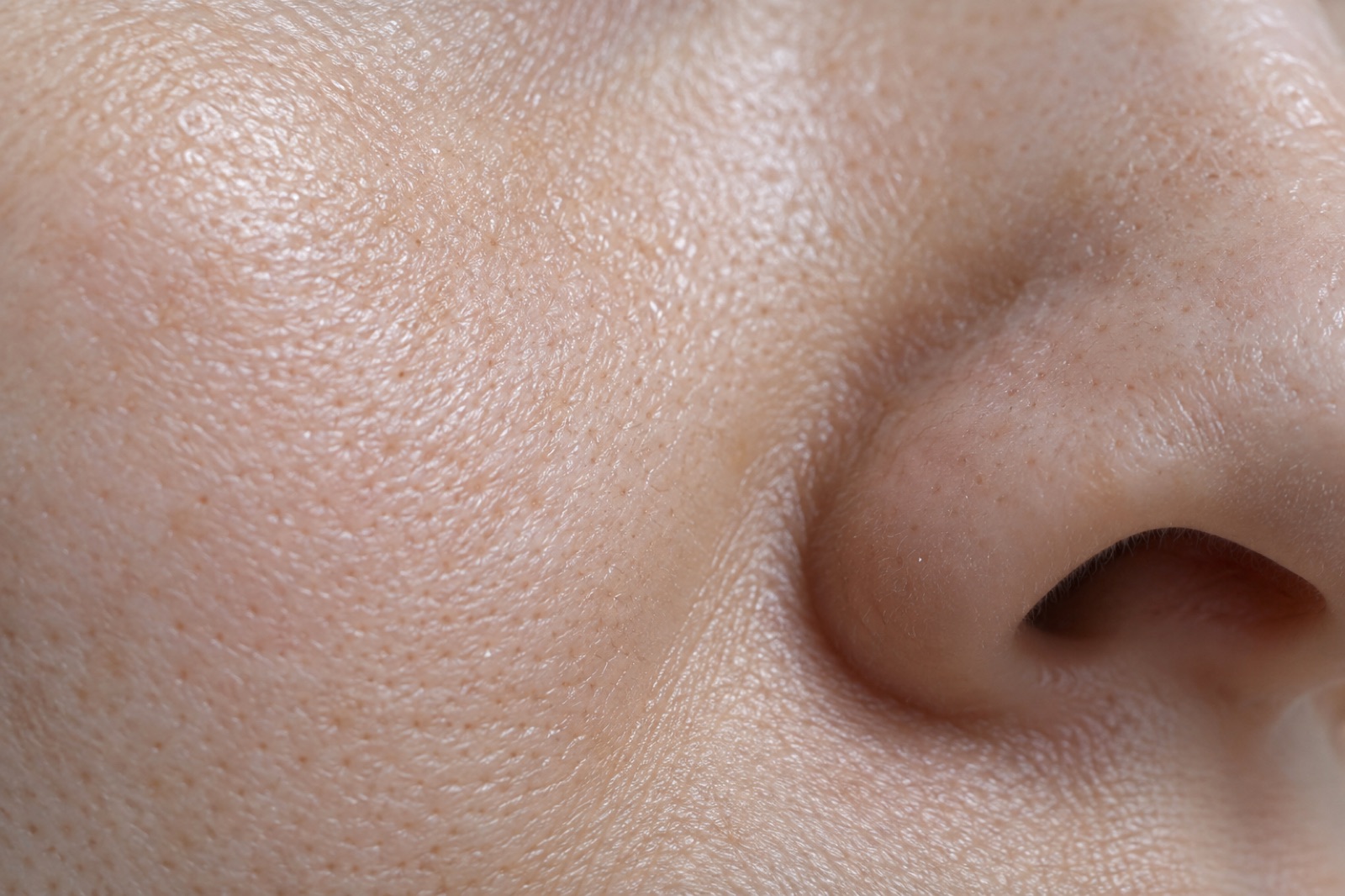
Cheeks and nose behave differently, so keep separate photos and notes for each. In a 2019 study that analyzed 19 people with oily skin using imaging techniques, the cheeks had a thinner outer skin layer and more large pores, the nose had higher sebum content, and on the chin, sebum, roughness and pore count moved together.
In weeks when you are focusing on cheek pores, don’t rub hard with your hands when washing, and limit new products to one. Because the Korean Dermatological Association names friction and mechanical irritation as factors that make acne worse, also note cheek-rubbing habits (resting your chin in your hand, wiping with a towel) in the memo column. For the butterfly-shaped area where the cheeks meet the nose (called the “butterfly zone” in Korea), cropping it out of the front photo and comparing it separately is handy.
Why do pores get clogged?
Clogging becomes more frequent when oily cosmetics or friction pile up on high-sebum days. The Korean Dermatological Association lists oily or pore-sealing cosmetics, friction and mechanical irritation, and heavy sweating as factors that can trigger or worsen acne.
The KDCA notes that on days you wear sunscreen or makeup, hair follicles can clog and acne becomes more likely, so double cleansing helps. That is why the log records not only photo days but also how many days you wore makeup that week, days you sweated and when you fell asleep. In a 2015 study of 40 women, forehead sebum changed more on nights they fell asleep later, so flag photos from weeks packed with exams or late work.
What ingredients are good for pores?
The evidence is still too weak to single out one ingredient. Many studies that measured pores tested finished products mixing several ingredients, and in a 2023 trial of a genistein combination cream (50 people, 6 weeks), pore area changed compared with before use, but the difference was not significant when compared directly with placebo, and redness actually increased.
In Korea, pores are also not among the three functional cosmetic categories that the Korean Dermatological Association describes as officially recognized. If you use an ingredient that can cause redness or stinging, such as retinol, log redness in the same table as your pore photos so you can read the results properly.
8-week pore photo log
| Week | When to shoot | Photos | Also note | Compare |
|---|---|---|---|---|
| Week 0 | Evening before starting a new product, 20 minutes after washing | 4 shots: front, left cheek, right cheek, beside the nose | Season, AC or heating, cycle day | Baseline photos |
| Week 2 | Same weekday and time as week 0 | Same 4 shots | Average time you fell asleep, days you wore makeup | Any redness or stinging |
| Week 4 | Same weekday and time | Same 4 shots | Days you sweated, days you got very shiny | Cheeks and nose vs. week 0, separately |
| Week 6 | Same weekday and time | Same 4 shots | Whether you changed any product | Flag photos taken under different conditions |
| Week 8 | Same weekday and time | Same 4 shots | Seasonal change over the 8 weeks | Side by side with week 0 |
| Week 10 | 2 weeks after pausing the product | Same 4 shots | Anything you changed during the break | Side by side with week 8 |
Flag photos taken in a month with a big temperature swing or in the week right before your period, and when you draw conclusions, only compare photos taken under similar conditions.
When is it time to see a dermatologist about your pores?
- If painful red lumps or pus keep coming back around your pores, see a dermatologist.
- If what seems to be increasing is sunken marks rather than pores, they may be scars, so a dermatology consultation is recommended.
- If you are looking into procedures such as lasers, discuss the benefits and side effects with a dermatologist.
Evidence summary for this guide
- In a 2007 split-face trial in which 52 Taiwanese people applied 4% niacinamide for 12 weeks (PMID 18047609), pores were measured with instruments at weeks 4, 8 and 12, and a difference from the placebo side was first reported at week 8.
- In a 2023 6-week trial in 50 postmenopausal women (PMID 36835861), the change in pore area with the combination cream was not significant when compared directly with placebo, and redness increased more than with placebo (+6.89% vs. -2.97%).
- In a 2015 study of 40 healthy women (PMID 25163854), forehead sebum changed more on nights they fell asleep later.
Frequently asked questions
How should you care for large pores on your cheeks?
Start by photographing and logging your cheeks separately from your nose. In a 2019 imaging study of 19 people with oily skin, the cheeks had a thinner outer skin layer and more large pores, while the nose had higher sebum content. Wash your cheeks without rubbing, change only one new product, and compare with 8 weeks of photos.
Why do pores get clogged?
The Korean Dermatological Association lists oily or pore-sealing cosmetics, friction and mechanical irritation, and heavy sweating as factors that can trigger or worsen acne. Korea's KDCA recommends double cleansing because sunscreen or makeup can clog hair follicles. Noting what you put on during weeks with frequent clogging narrows down the possible causes.
What ingredients are good for pores?
The evidence for singling out one ingredient is still weak. In a 12-week split-face trial in 52 Taiwanese people using 4% niacinamide, a difference from the placebo side in pore measures was reported at week 8, but many other studies tested finished products mixing several ingredients. Pores are also not among the three functional cosmetic categories the Korean Dermatological Association describes for Korea, so checking any ingredient yourself with same-condition photos is the realistic approach.
Sources
- Kinetin and niacinamide split-face RCT, 52 Taiwanese people, 12 weeks, 2007 (PMID 18047609)A
- Genistein, vitamin E, niacinamide and ceramide cream in 50 postmenopausal women, 6 weeks, 2023 (PMID 36835861)A
- Multicenter RCT of a three-product defensin skin care regimen, 44 women, 12 weeks, 2018 (PMID 29601620)A
- Low-molecular-weight collagen peptide intake RCT, 70 adults, 8 weeks plus 2-week washout, 2025 (PMID 40935395)A
- Seasonal changes in facial skin with and without acne, measured monthly for 1 year, 2015 (PMID 26091385)B
- Sleep patterns and fluctuations in forehead sebum secretion, 40 women, 2015 (PMID 25163854)B
- Regional characteristics of oily skin assessed by imaging techniques, 19 people, 2019 (PMID 30971936)B
- Korea Disease Control and Prevention Agency (KDCA) National Health Information Portal — Acne (Korean)Institutional
- Korean Dermatological Association — Dermatologic therapies: functional cosmetics (Korean)Institutional
- Korean Dermatological Association — Acne vulgaris (Korean)Institutional
Videos and forum posts never count as evidence for a fact here. Full rules: Editorial policy